

"His mercy endures forever." - 12-04-2026
Second Sunday of Easter (Divine Mercy Sunday)
First Reading
Acts 2,42-47.
They devoted themselves to the teaching of the apostles
and to the communal life, to the breaking of bread and to the prayers.
Awe came upon everyone, and many wonders
and signs were done through the apostles.
All who believed were together and had all things in common;
they would sell their property and possessions
and divide them among all according to each one's need.
Every day they devoted themselves to meeting together
in the temple area and to breaking bread in their homes.
They ate their meals with exultation and sincerity of heart,
praising God and enjoying favor with all the people.
And every day the Lord added to their number those who were being saved.
Responsorial Psalm
Ps 118(117),2-4.13-15.22-24.
Let the house of Israel say,
"His mercy endures forever."
Let the house of Aaron say,
“His mercy endures forever.”
Let those who fear the LORD say,
“His mercy endures forever.”
I was hard pressed and was falling,
but the LORD helped me.
My strength and my courage is the LORD,
and he has been my savior.
The joyful shout of victory
in the tents of the just:
The stone which the builders rejected
has become the cornerstone.
By the LORD has this been done;
it is wonderful in our eyes.
This is the day the LORD has made;
let us be glad and rejoice in it.
Second Reading
1 Pet 1,3-9.
Blessed be the God and Father of our Lord Jesus Christ,
who in his great mercy gave us a new birth to a living hope
through the resurrection of Jesus Christ from the dead,
to an inheritance that is imperishable, undefiled,
and unfading, kept in heaven for you
who by the power of God are safeguarded through faith,
to a salvation that is ready to be revealed in the final time.
In this you rejoice, although now for a little while you
may have to suffer through various trials,
so that the genuineness of your faith, more precious
than gold that is perishable even though tested by fire,
may prove to be for praise, glory,
and honor at the revelation of Jesus Christ.
Although you have not seen him you love him;
even though you do not see him now yet believe in him,
you rejoice with an indescribable and glorious joy,
as you attain the goal of (your) faith, the salvation of your souls.
Gospel
John 20,19-31.
On the evening of that first day of the week,
when the doors were locked, where the disciples were,
for fear of the Jews, Jesus came and stood in their midst
and said to them, «Peace be with you.»
When he had said this, he showed them his hands
and his side. The disciples rejoiced when they saw the Lord.
(Jesus) said to them again, "Peace be with you.
As the Father has sent me, so I send you."
And when he had said this, he breathed on them
and said to them, "Receive the holy Spirit.
Whose sins you forgive are forgiven them,
and whose sins you retain are retained."
Thomas, called Didymus, one of the Twelve,
was not with them when Jesus came.
So the other disciples said to him, "We have seen the Lord."
But he said to them, "Unless I see the mark of the nails
in his hands and put my finger into the nailmarks
and put my hand into his side, I will not believe."
Now a week later his disciples were again inside
and Thomas was with them. Jesus came,
although the doors were locked, and stood in their midst
and said, "Peace be with you."
Then he said to Thomas, "Put your finger here
and see my hands, and bring your hand and put it into my side,
and do not be unbelieving, but believe."
Thomas answered and said to him, "My Lord and my God!"
Jesus said to him, "Have you come to believe
because you have seen me? Blessed are those
who have not seen and have believed."
Now Jesus did many other signs in the presence of (his) disciples
that are not written in this book.
But these are written that you may (come to) believe
that Jesus is the Messiah, the Son of God, and that through
this belief you may have life in his name.
YOUCAT Reflection
314 How do we know that God is merciful?
In many passages in Sacred Scripture God shows that he is merciful, especially in the parable of the merciful father (Lk 15) who goes out to meet his prodigal son, accepts him unconditionally, and celebrates his return and their reconciliation with a joyful banquet.
Already in the Old Testament God says through the prophet Ezekiel, "I have no pleasure in the death of the wicked, but that the wicked turn from his way and live" (Ezek 33,11). Jesus is sent "to the lost sheep of the house of Israel" (Mt 15,24), and he knows that "Those who are well have no need of a physician, but those who are sick" (Mt 9,12). Therefore he eats with tax collectors and sinners, and then toward the end of his earthly life he even interprets his death as an initiative of God's merciful love, "This is my blood of the covenant, which is poured out for many for the forgiveness of sins" (Mt 26,28).
________________________________________________________________________________________
Jesus entrusted to them the gift of "forgiving sins", a gift that flows from the wounds in his hands, his feet, and especially from his pierced side. From there a wave of mercy is poured out over all humanity. Let us relive this moment with great spiritual intensity. Today the Lord also shows us his glorious wounds and his heart, an inexhaustible source of light and truth, of love and forgiveness.
The Heart of Christ! His "Sacred Heart" has given men everything: redemption, salvation, sanctification. St Faustina Kowalska saw coming from this Heart that was overflowing with generous love, two rays of light which illuminated the world.
Through the mystery of this wounded heart, the restorative tide of God's merciful love continues to spread over the men and women of our time. Here alone can those who long for true and lasting happiness find its secret.
"Jesus, I trust in you". This prayer, dear to so many of the devout, clearly expresses the attitude with which we too would like to abandon ourselves trustfully in your hands, O Lord, our only Saviour.
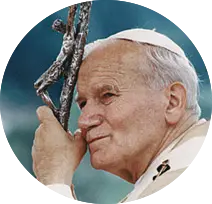
Pope John Paul II, 22 April 2001