
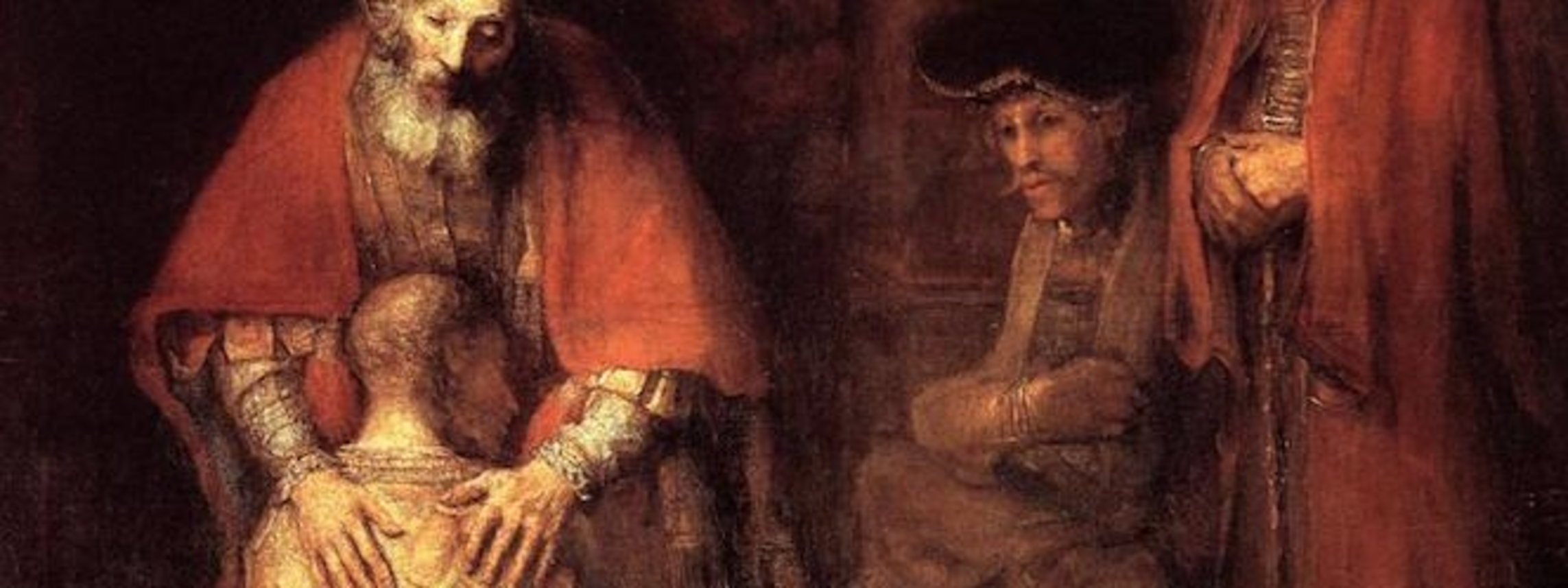
I'll go back to my father - 07-03-2026
Saturday of the Second week of Lent
Readings Responsorial Psalm Gospel YOUCAT Reflection
First Reading
Mic 7,14-15.18-20.
Shepherd your people with your staff,
the flock of your inheritance,
That dwells apart in a woodland, in the midst of Carmel.
Let them feed in Bashan and Gilead, as in the days of old;
As in the days when you came from the land of Egypt,
show us wonderful signs.
Who is there like you, the God who removes guilt
and pardons sin for the remnant of his inheritance;
Who does not persist in anger forever,
but delights rather in clemency,
And will again have compassion on us,
treading underfoot our guilt?
You will cast into the depths of the sea all our sins;
You will show faithfulness to Jacob,
and grace to Abraham,
As you have sworn to our fathers from days of old.
Responsorial Psalm
Ps 103(102),1-2.3-4.9-10.11-12.
Bless the LORD, O my soul;
and all my being, bless his holy name.
Bless the LORD, O my soul,
and forget not all his benefits.
He pardons all your iniquities,
he heals all your ills.
He redeems your life from destruction,
he crowns you with kindness and compassion.
He will not always chide,
nor does he keep his wrath forever.
Not according to our sins does he deal with us,
nor does he requite us according to our crimes.
For as the heavens are high above the earth,
so surpassing is his kindness toward those who fear him.
As far as the east is from the west,
so far has he put our transgressions from us.
Gospel
Luke 15,1-3.11-32.
Tax collectors and sinners were all drawing near to listen to Jesus,
but the Pharisees and scribes began to complain, saying,
"This man welcomes sinners and eats with them."
So to them he addressed this parable.
Then he said, "A man had two sons,
and the younger son said to his father,
'Father, give me the share of your estate that should come to me.'
So the father divided the property between them.
After a few days, the younger son collected all his belongings
and set off to a distant country where he squandered
his inheritance on a life of dissipation.
When he had freely spent everything,
a severe famine struck that country,
and he found himself in dire need.
So he hired himself out to one of the local citizens
who sent him to his farm to tend the swine.
And he longed to eat his fill of the pods on which the swine fed,
but nobody gave him any.
Coming to his senses he thought, 'How many of my father's hired workers
have more than enough food to eat,
but here am I, dying from hunger.
I shall get up and go to my father and I shall say to him,
"Father, I have sinned against heaven and against you.
I no longer deserve to be called your son;
treat me as you would treat one of your hired workers."'
So he got up and went back to his father.
While he was still a long way off, his father caught sight of him,
and was filled with compassion. He ran to his son, embraced him and kissed him.
His son said to him, 'Father, I have sinned against heaven
and against you; I no longer deserve to be called your son.'
But his father ordered his servants, 'Quickly bring the finest robe
and put it on him; put a ring on his finger and sandals on his feet.
Take the fattened calf and slaughter it. Then let us celebrate with a feast,
because this son of mine was dead, and has come to life again;
he was lost, and has been found.' Then the celebration began.
Now the older son had been out in the field and,
on his way back, as he neared the house,
he heard the sound of music and dancing.
He called one of the servants and asked what this might mean.
The servant said to him, 'Your brother has returned
and your father has slaughtered the fattened calf
because he has him back safe and sound.'
He became angry, and when he refused to enter the house,
his father came out and pleaded with him.
He said to his father in reply, 'Look, all these years I served you
and not once did I disobey your orders;
yet you never gave me even a young goat to feast on with my friends.
But when your son returns who swallowed up your property with prostitutes,
for him you slaughter the fattened calf.'
He said to him, 'My son, you are here with me always;
everything I have is yours.
But now we must celebrate and rejoice,
because your brother was dead and has come to life again;
he was lost and has been found.'"
YOUCAT Reflection
227 Who instituted the sacrament of Penance?
Jesus himself instituted the sacrament of Penance when he showed himself to his apostles on Easter day and commanded them, "Receive the Holy Spirit. If you forgive the sins of any, they are forgiven; if you retain the sins of any, they are retained" (Jn 20,22a–23).
Nowhere did Jesus express more beautifully what happens in the sacrament of Penance than in the parable of the Prodigal Son, We go astray, we are lost and can no longer cope. Yet our Father waits for us with great, indeed, infinite longing; he forgives us when we come back; he takes us in again, forgives our sins. Jesus himself forgave the sins of many individuals; it was more important to him than working miracles. He regarded this as the great sign of the dawning of the kingdom of God, in which all wounds are healed and all tears are wiped away. Jesus forgave sins in the power of the Holy Spirit, and he handed that power on to his apostles. We fall into the arms of our heavenly Father when we go to a priest and confess.